
Founder Profile · Hospemag
Inside EkoStay with
Varun Arora
CEO & Co-founder, EkoStay
“
EkoStay is like a millennial who saw the dot-com era. Landline to a mobile to a smartphone. That's how it feels like for us.
That line is not a flourish. It is a field report.
I am talking to Varun Arora, CEO & co-founder, EkoStay.
In the span of a few years, alternate accommodation in India has moved through eras quickly. Guest expectations have upgraded faster than infrastructure. Competition has arrived in waves. Owners have become more discerning. Reviews have become more weaponised. What used to feel like a friendly home-stay now has to deliver like a hotel, with the unpredictability of a home, and the scrutiny of a brand.
If you want to understand what that acceleration does to operators, look at the most unforgiving rhythm of villa hospitality. 11am check-out. 2pm check-in. Three hours to erase evidence of the last guest and prepare for the next one's standards. Beds remade, bathrooms reset, linen counted, inventory checked, damage documented, water temperatures tested. Sometimes the departing guest leaves late. Sometimes the arriving guest turns up early. Sometimes there is no "mess" at all. There is an incident. And by the time the next doorbell rings, the house still has to look like nothing happened.
That compressed window is where founders either build systems, or burn out. Varun Arora built systems.
EkoStay began in 2018, bootstrapped, built from the ground up by four co-founders, and profitable till date. Varun, his cousin Sohail Mirchandani, and partners Husain Khatumdi and Zishan Khan came into the alternate accommodation space early, when the category was still forming in India. Their origin story is not a romantic one. It is practical. They were already sitting on inventory. The real estate market changed. The business needed a pivot. So they started taking bookings in other people's homes, learnt the game on the fly, and then went all-in.
In Varun's telling, the early days were all lived experience. The founders handled sales, ran operations, negotiated with homeowners, procured materials, dealt with vendors, and managed the problems that turn up without warning. That bottom-up education would later become their edge. It gave them credibility with their teams. It also gave them a distinct point of view about what hospitality actually demands.
The founder who shares the struggle
Scroll through Varun's LinkedIn and you see a pattern. He writes as he builds. He shares decisions, lessons, frustrations, and the unglamorous parts of running a hospitality business.
“
Entrepreneurship is quite glorified over and above what it actually is. There are late nights, sleepless nights, tensions, things that come up at 3am or 5am. You have to tackle it then and there.
He does it because, in his words, entrepreneurship is excessively glorified. The real job is not the title. It is the work. The late nights. The "deal with it right now" moments. The kind of problems that do not wait for a Monday morning meeting.
There is a discipline to the transparency. It is not performance. It is an operator's instinct to document reality.
That instinct also shows up in how EkoStay has structured itself. The four co-founders have clear departmental ownership. Varun's domain includes marketing, food and beverage, and property acquisition. He also built the Goa market from scratch and stays closely involved in how it runs.

Varun Arora, CEO & Co-Founder of EkoStay
Three tiers, one intent: make it work at scale
EkoStay operates three categories. Original, Gold, and Luxe. The tiers are not just branding. They are meant to signal the experience level, the physical standards of the home, and the service capacity behind it.
Gold, Varun explains, is often a structural upgrade rather than a service upgrade. Luxe is where the service shift becomes visible. Better trained caretakers, more prompt responses, and experiences packaged more deliberately.
For guests, the tiering is simple. For operators, it is an internal checklist, an assurance system. It is a way to protect standards while growing.
The model difference: control
In a crowded space with funded competitors, EkoStay's model is a defining advantage. Around 80% of its portfolio operates on a fixed rental model, as opposed to the revenue-share model many competitors run.
The implication is huge. Fixed rental gives EkoStay autonomy. It decides the pricing. It decides the capacity. It decides how the home is positioned. And crucially, it can rework a home without an owner calling the shots every day.
That freedom has translated into transformation work that most operators would charge for. Varun speaks about turning homes around as if it were a "pet project". They have renovated and transformed more than 70 homes and built over a three dozen pools for owners, often at zero additional advisory cost. In many cases, they have brought vendors, negotiated rates, and pushed quality standards, while telling owners plainly: beat the price if you can, just keep the quality.
It is a very non-extractive posture for a business. But it creates loyalty. It also creates a strong pipeline of owners who prefer to work with an operator that understands construction realities and guest expectations.

Black Mirror, Igatpuri
Chapter One
Behind the scenes: the 11-to-2 battle
To understand EkoStay, you have to understand the part guests never see.
Varun describes the most unforgiving rhythm of villa hospitality. A guest checks out at 11am. The next guest checks in at 2pm. In theory.
In practice, the departing guest leaves at 12:30. The arriving guest turns up at 12. Someone has a child. Someone wants the bathroom. Someone starts taking photos and threatening a refund because the place is "dirty", while the team is still cleaning.
And then there are the incidents.
Varun recounts an extreme case where there was blood "all over the place". On the staircase, curtains, sofa. It happened at 3am. By the next check-in, everything needed to look like nothing happened. Curtains replaced. Sofas managed. Logistics solved in a destination where you cannot just "go to a shop" and buy replacements instantly.
This is where the details matter. This is where founders either build systems or burn out.
EkoStay's answer has been process discipline. Pre check-in photos. Tracking early arrivals. Clear documentation. A refusal to argue publicly online, even when reviews are one-sided. Damage control, yes. Public mudslinging, no.
“
Guest is king. He can abuse you, but you can't abuse him in return.
Varun says, and the sadness in that line is familiar to anyone who has run hospitality at scale. Teams absorb abuse. Operators cannot respond in kind. Yet the brand must hold.

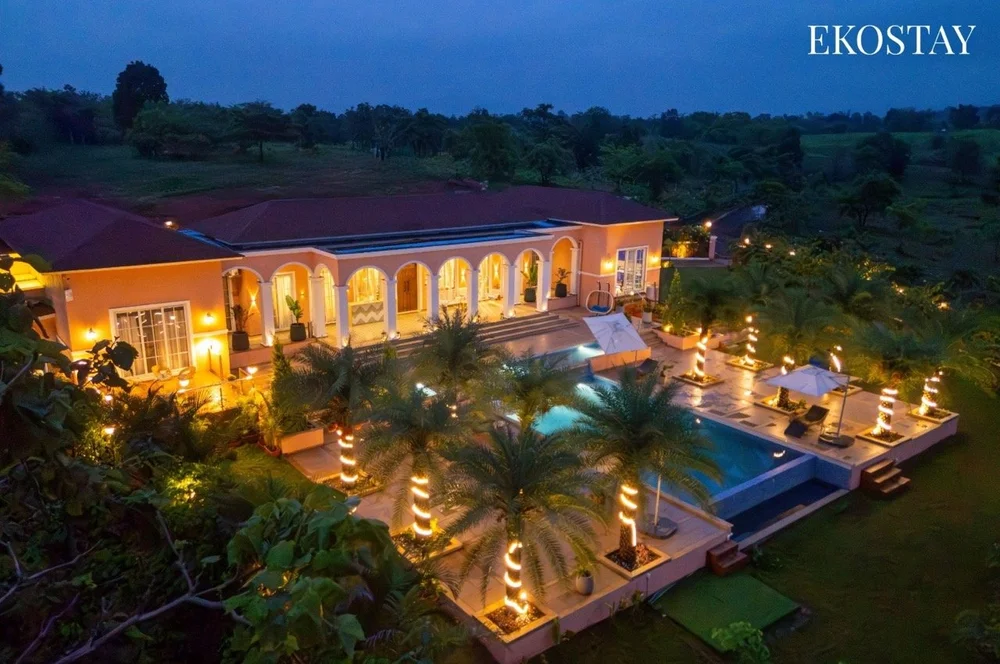
Infinity Villa, Lonavala
When the lights go out at 2am
Varun's operational life is full of moments that feel like short stories.
In the early days, one villa had no electricity. Only an inverter, and no generator. After two hours, the backup died. There were kids. An infant. The family wanted milk heated.
All the co-founders who were in Lonavala, showed up. At 2am, they were physically shifting inverters between units to give a few more hours of backup.
The guest was angry anyway. The reviews did not care that the electricity department was a government system with no service guarantees. The guest saw one thing: discomfort.
That is the job. Solve the problem. Take the hit. Learn. Then upgrade.
Today, Varun says the pricing is deliberately tied to infrastructure. A standard villa without a generator is priced accordingly. If guests want generator-backed comfort, Gold or Luxe exists for that reason. But a recurring reality remains: many guests want luxury at budget pricing.
Chapter Two
The tech stack behind the scale
EkoStay's operations are supported by a mix of custom and off-the-shelf systems.
They use Zoho for accounts and operations, with custom models built around their workflows. They have a custom backend for booking management and CRM hosted on their own server. The team is experimenting with Claude Teams and planning a move to Claude Enterprise. For ground-team payments, they use a customised third-party app called Haeywa, designed around their transaction needs.
Training and SOPs sit in video and PDF formats, often translated into local languages for the ground teams. Daily images and videos are reviewed by operations analysts as system checks.
None of this is glamorous. All of it is essential.

Casa Noah Lonavala
Goa: from cash cow to cash flow
Varun built Goa for EkoStay from scratch. Today the company runs around 25 properties in the state, alongside a corporate office base of around 50 people in Mumbai, and close to 200 people on the ground (a mix of payroll and agency).
He has seen Goa's demand transform dramatically, especially post-COVID. Areas like Assagao, once unknown to many travellers, became the most requested overnight. Homeowners saw revenue potential and entered the space themselves. Supply exploded.
But there is also a larger behavioural shift. Guests increasingly want lesser-known destinations. Not the most commercial hub, but the places slightly further out, with openness, views, and space. Better roads and more comfortable cars have made it easier to travel longer for better scenery. Infrastructure has changed the demand map.

Casa Zul, Alibaug
Chapter Three
The next wave, the dream
“I'm looking forward to automation. Not just from a system standpoint but from a labour standpoint as well."
The dream is simple: the kind of reliable machine-led consistency that does not require constant supervision. If a cleaning machine can do "every nook and corner" without someone standing over it, imagine what that does for an industry built on invisible labour.
“
I need to have a footprint in every state in India.
Then, a global expansion into established, nearby markets like the Middle East and Southeast Asia. Dubai. Abu Dhabi. Oman. Thailand. Malaysia.
The strategy is equally clear. Enter where demand is known. Build credibility so that homeowners and guests recognise the brand before EkoStay arrives.
EkoStay is not chasing valuations. It is not burning cash to add inventory for investor decks.
“
We have been profitable since inception, year on year. We are not in the rat race to create a valuation and just add inventory for the sake of adding inventory.
Varun points out that many funded competitors are not profit-making because their incentives are built around valuation growth, not operational health.
EkoStay's approach is slower, steadier, and deeply operational. It is built on obsession with details. It is built on founders who learnt the business by doing the work, not delegating it.
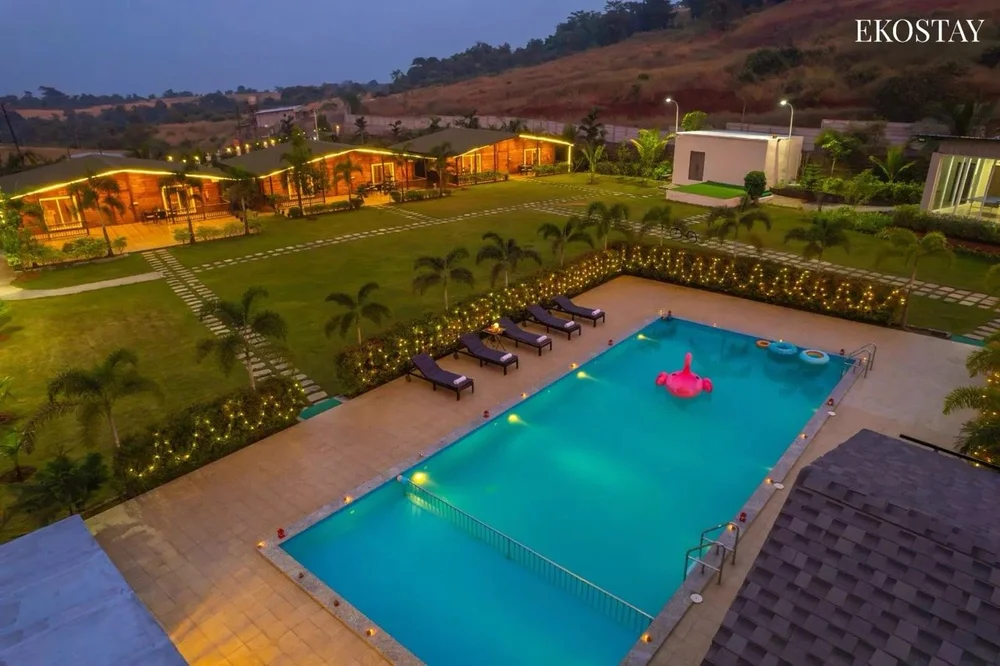
Woodstock Villa, Karjat
Hospemag