
The Stalwart of Catering Industry:
Sanjeev Kumar

A man can build a banquet the way some people build a life. Quietly. Repeatedly. With a discipline so consistent it begins to look like instinct.
When I met Sanjeev Kumar, what struck me first was not the scale of what he has done. It was the way he carried it. Kind. Meticulous. Unhurried. A storyteller who does not perform. Someone who simply remembers, clearly, because the work mattered enough to be stored properly.
In India, catering is often spoken about as a trade. A hustle. A back-of-house scramble that appears only when the lights come on and the guests arrive. But listening to Sanjeev, you start to see it differently. Catering as a career. As a craft. As a long game built on planning, standards, timing, and the invisible choreography that makes a thousand plates feel effortless.
The long road to “king of banquets”
His story does not begin with glamour. It begins with the kind of disillusionment that most people do not admit to. The kind that makes you question whether the work is worth it.
He spoke about a moment that stayed with me.
He had joined hotel management with the usual optimism of someone stepping into a professional world. Then came his first ODC. The reality of it felt jarring. Disconcerting enough that he walked away thinking, simply, this is not for me.
The next morning, at breakfast, his father asked why he had not gone to college. Sanjeev told him he did not want to do hotel management anymore.
His father did not argue. He just said, “papa ka hotel bandh hai.”
It was not drama. It was a fact. A line that closed every escape route in one stroke. And for Sanjeev, it was enough. If he was going to choose this path, he would make it work. He would make it matter. He would make it a success.
And then, the other kind of sentence, the one you decide to live by. The one that comes after. Not spoken loudly. Not posted. Simply acted out, day after day, event after event, until the industry starts repeating your name back to you.
From that arc comes the reputation. The “king of banquets” label people use when they do not have better language for someone who seems to know every corner of the function. Food, service, flow, guest psychology, staffing, vendor dynamics, crisis management. The tiny things. The make-or-break things.
A life learned on the floor
What makes Sanjeev different is that the knowledge is not borrowed. It is earned. You can hear it in the specificity. You can feel it in the calm way he speaks about pressure, as if pressure is just another ingredient to measure properly.
He has learned by experience, and then he has done something rare. He has tried to give it back.
Teach. Mentor. Grow the next generation. Not as a motivational tagline, but as a responsibility. As if the industry that shaped him deserves to be left more organised than he found it.
There is a particular authenticity that comes from people who have paid real prices for their professionalism. He told me, matter-of-factly, about missing the birth of his child to meet a client. There is no heroism in the way he says it. Only the raw truth of what service, ambition, and obligation can demand.
You do not romanticise that. But you do respect what it reveals. The level of commitment. The era of hospitality that required it. And the need, now, to build systems that do not force that cost on the next generation.
What the catering industry forgets to honour
India’s events and wedding economy is enormous, by some accounts 60K Crore per year. It is also still, in many places, under-structured. We celebrate celebrity chefs and hotel brands. We rarely celebrate the operators who made scale possible. The ones who turned chaos into rhythm. The ones who taught teams to execute, not just to “manage”.
Sanjeev represents that lineage. The hidden architects of guest experience outside the hotel lobby. The people who make a thousand-person event feel intimate. Who understand that hospitality starts with intention.
And perhaps this is why the book about him exists.
The book that tried to hold a career in one place
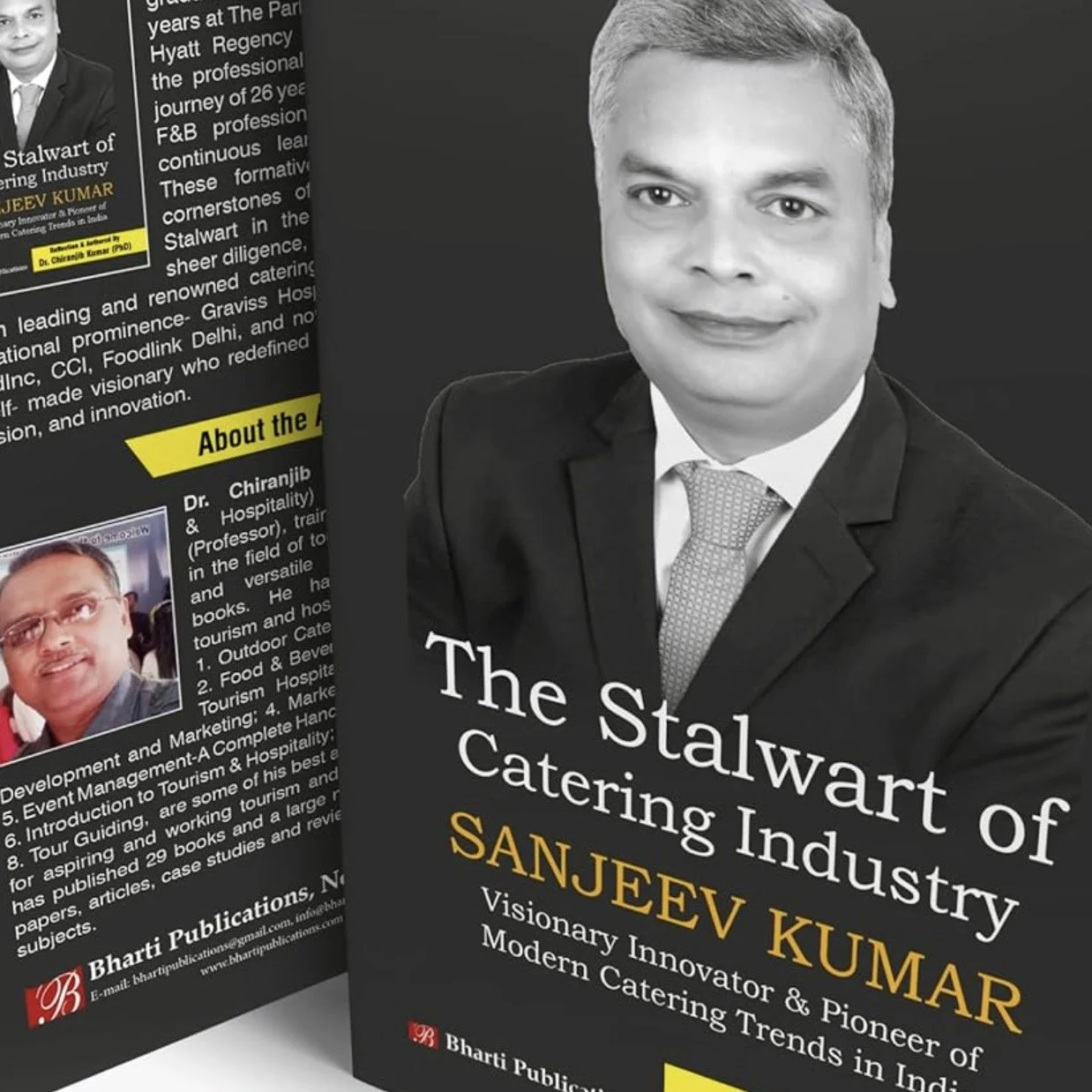
Sanjeev’s journey has been documented in The Stalwart of Catering Industry: Sanjeev Kumar – Visionary Innovator & Pioneer of Modern Catering Trends in India, written by Dr. Chiranjib Kumar Choudhary.
Legacy is a word the industry uses too lightly. But there is something quietly right about documenting practitioners like this. Not because every detail must be mythologised. Because the work deserves to be visible. Because young professionals deserve to see that catering can be a serious, respected path. And because operational excellence, when done at this level, is not accidental. It is taught.
Why buy and read it
- A real operator’s education in what it takes to execute large events without chaos
- A career proof-point that catering is not “side work”. It is a serious profession with a ladder, dignity, and craft
- Lessons you can borrow. Planning, timing, team rhythms, guest psychology, and how good banquets are actually built
- A human story of grit and choice. The disillusionment, the turning point, and the decision to make the path work
- A mentor’s lens. The impulse to teach, to give back, and to leave the industry more organised than you found it
Why this conversation matters now
In a time where hospitality is being re-imagined through tech, brands, and new guest expectations, it is easy to forget the fundamentals. Timing. Standards. Service flow. Human coordination. Pride in preparation.
Sanjeev reminded me that innovation in catering is often not a new gadget or a fancy plating trend. It is the willingness to bring structure to what was once informal. To insist that the work be respected. To build teams that can deliver excellence at scale, again and again.
If you want to understand where modern catering in India is headed, spend time with people who have already built it once.
And if you want to understand the soul of hospitality, listen to the ones who never needed a spotlight to do the job well.