The ₹7,500 Question: What the GST Council's New Input-Tax-Credit Offer Really Means for Mid-Market Hotels
/By Hospemag
When the GST Council said on 8 October that hotels charging up to ₹7,500 a night could get input tax credit again, many mid-market owners read it as the relief they had been asking for since September 2025. Read the fine print, though, and it is a much narrower change. For most hotels that sell their own rooms, it will barely touch the cost line that hurts.
Here is what the Council actually proposed, what it leaves untouched, and what owners and GMs should do while they wait for the notification.
What changed, and what didn't
At its 57th meeting, held in New Delhi on 8 October 2026, the Council recommended allowing "limited input tax credit in the same line of business" for restaurant and outdoor catering services, gym and fitness services, and hotel accommodation valued up to ₹7,500 per unit per day. It would work "in the same manner as is currently available for passenger transportation services, tour operator services and renting of motor vehicles services".
The Council's own FAQs spell out what that means. Credit would be allowed to a reseller who suffers cascading tax because ITC is blocked "in respect of the same category of service used as an input service for supplying the same category of output service". The FAQs also ask whether all ITC is now allowed in the 5% segment, and the answer is: "No, only the limited input tax credit in respect of same category of input service."
So the GST on rent, outsourced manpower, maintenance, utilities, linen, technology and refurbishment stays blocked. No GST rate has changed either. And this is still a recommendation, not law. It takes effect only once notifications, circulars or legal amendments are issued. As of 19 October 2026, we could find no CBIC notification putting it into effect.
How GST on rooms works today
Since 22 September 2025, under GST 2.0, hotel rooms fall into two bands:
Up to ₹7,500 per unit per day: 5% GST, without ITC. Before the reform, this band paid 12% with ITC.
Above ₹7,500: 18% GST, with full ITC.
The Finance Ministry confirmed in September 2025 that the 5% rate is mandatory. In its words, "the option to pay GST at 18 per cent with ITC is not available for such units." Restaurants follow the same split. Restaurants in hotels below the band pay 5% without ITC, while those in hotels above it pay 18% with ITC.
Guests noticed the change. A year on, Animesh Kumar, Commercial Head of ibis and ibis Styles India, told CNBC-TV18 that ₹7,500 has become "a price point that guests are more conscious of", although location and purpose of travel still decide most bookings.
A worked example (illustrative only)
Assumptions: a room sold at ₹5,000 before tax. Purchases that carry 18% GST (utilities, maintenance, outsourced services and so on) cost 40% of room revenue, or ₹2,000 before tax, with ₹360 of GST on top. Payroll and other costs are ignored. These are round numbers to show how the mechanics work, not benchmarks.
Before 22 Sep 2025 (12% with ITC): The guest paid ₹5,600. The hotel set the ₹360 of input GST against its ₹600 of output tax, so the input tax cost it nothing. That left ₹3,000 per room night after those purchases.
Today (5% without ITC): The guest pays ₹5,250. The ₹360 becomes a cost, leaving ₹2,640, which is ₹360 less, or about 12% lower.
After the proposal, for a hotel selling its own rooms: Still ₹2,640. None of those inputs is "hotel accommodation", so none of them qualifies.
Some hotels took a different route and kept the guest's all-in price at ₹5,600 by raising the base rate to about ₹5,333. That leaves roughly ₹2,973 after purchases and recovers most of the loss. Pricing, not the new credit, remains the lever owners actually control.
Capex is where it hurts most. FHRAI has pointed out that a ₹1 crore refurbishment now carries ₹18 lakh of GST that can't be recovered. Nothing in this proposal changes that.
Who gains and who doesn't
Likely to gain:
Businesses that buy rooms in their own name and resell them, such as travel companies, tour operators and room-block resellers.
Hotels that buy rooms from a neighbouring property for overflow or group business and bill the guest themselves.
Hotels that buy restaurant, catering or fitness services and supply them onward in the same line. One example is outsourced F&B, a model HOTELiVATE's Manav Thadani has flagged as growing. This depends on how the rules are worded.
ETHospitalityWorld's analysis on 19 October offered a simple illustration. A reseller that buys a ₹6,000 room pays ₹300 of GST it can't recover today. Under the proposal it could offset that ₹300, but whether the guest sees any of the saving is the reseller's call. The Hindu BusinessLine argues the change should put direct and intermediated bookings "on a more equal footing".
Unlikely to gain: the typical owner-operated budget or mid-scale hotel that sells direct or through an OTA. An OTA commission is an intermediary service, not accommodation, so the 18% GST on it stays a cost.
What the industry asked for
The industry asked for far more than this. FHRAI wanted ITC restored at 5%, or at least 75% of it. It also wanted hotel rooms treated as "plant and machinery" for refurbishment credit and the threshold raised to ₹12,500. HAI urged the government to "retain the rate at 5% whilst allowing ITC". HRAWI proposed 5% with 50% ITC as one option. Chalet Hotels' Sanjay Sethi suggested ₹12,000 with ITC, indexed to CPI.
As of 19 October, we found no formal response from FHRAI, HAI or HRAWI to the 8 October recommendation itself. Early comments from operators have mostly welcomed the simpler compliance and faster refunds.
What owners should do now
Map your purchases. List every input that is itself accommodation, restaurant, catering or fitness service bought for onward supply. That is the only pool that could qualify.
Check how you invoice. If you buy rooms for groups or overflow, decide whether the guest is billed by you or by the other hotel. Under the proposal, that could decide whether credit is available.
Look at outsourced F&B and fitness contracts. Check who the supplier is and how they bill you.
Keep clean records of GSTINs, invoices and the matching between inputs and outputs, ready for when the rules arrive.
Revisit pricing around ₹7,500. Rate strategy will do more for your margin than this credit.
Don't book any credit until it has been notified.
Open questions until notification
When will it take effect, and will it apply only from that date?
How exactly will "same category of service" be defined, for example for packages that bundle a room with meals?
How will common credits be split at hotels with rooms both above and below ₹7,500?
Will the ₹7,500 threshold, unchanged for years, finally be revisited?
Until those answers arrive, the ₹7,500 question is mostly still open for owners who sell their own rooms. For the earlier industry pushback, read FHRAI's case on Hospemag.
This article is for general information and is not tax advice. Owners should consult their chartered accountant before acting.
Sources
CNBC-TV18: What could change for hotels and restaurants (9 Oct 2026)
Business Standard: No ITC for rooms up to ₹7,500, says FinMin (16 Sep 2025)
Business Standard via NRAI: FHRAI meets FM; HRAWI's 50% ITC proposal (14 Oct 2025)
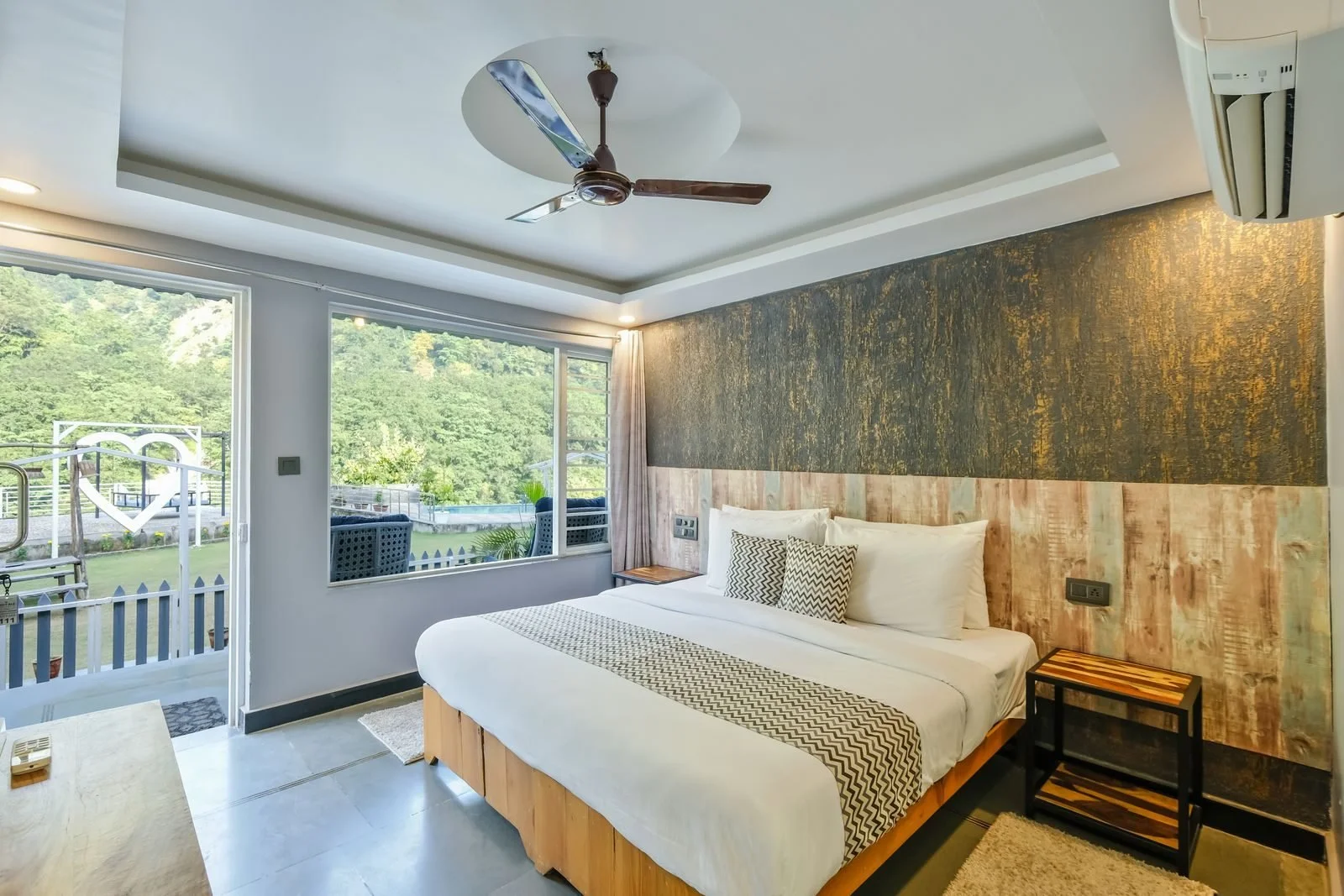
Image: Moustache Escape / Pexels (Pexels Licence)