Women’s Bus Travel Surges 136% Since 2019, Outpacing Overall Passenger Growth: redBus Pink report
/
National, March, 2026: redBus, the world’s largest online bus ticketing platform, released insights from its first-of-a-kind redBus Pink Report during International Women’s Week. Based on internal data between 2019 and 2025, the report highlights a steady rise in how women are reshaping India’s intercity mobility landscape. According to the study, women’s bus travel has surged by 136% since 2019, nearly double the pace of overall passenger growth at 72%. Women now make up one in three intercity bus travellers (33%), up from 23% in 2019, with much of the momentum driven by Gen Z travellers, rising solo journeys, and growing adoption across Tier-2 and Tier-3 towns. Together, these trends highlight a broader shift towards greater independence, participation, and mobility for women across India.
The redBus Pink Report is a data-driven analysis of women’s intercity and interstate bus travel across India, categorising states based on women’s travel patterns. Built using redBus’ internal data between 2019 and 2025 across both private and RTC (government) buses available on the redBus platform, the study tracks how women’s bus travel has evolved and highlights regions where adoption is accelerating. The study aims to highlight women’s travel trends across regions and contribute to broader mobility discussions.
Here is the link to the full report:
Key highlights:
Women Are Driving the Growth of Intercity Bus Travel
136% increase in women travelling in 2025, compared to 2019, outpacing overall passenger growth, which stands at 72%
Women’s share of bus travellers increased from 23% in 2019 to 33% in 2025
The Rise in Women Bus Travel Is a Pan-India Phenomenon
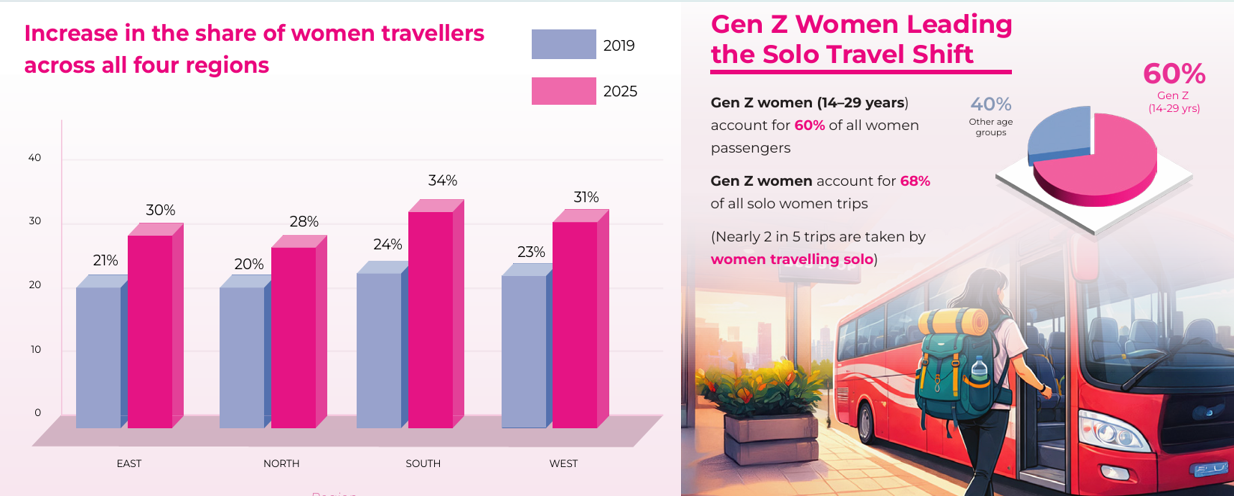
South India continues to lead women’s bus travel participation, rising from 24% in 2019 to 34% in 2025, while other regions have also seen steady growth - West from 23% to 31%, East from 21% to 30%, and North from 20% to 28%.
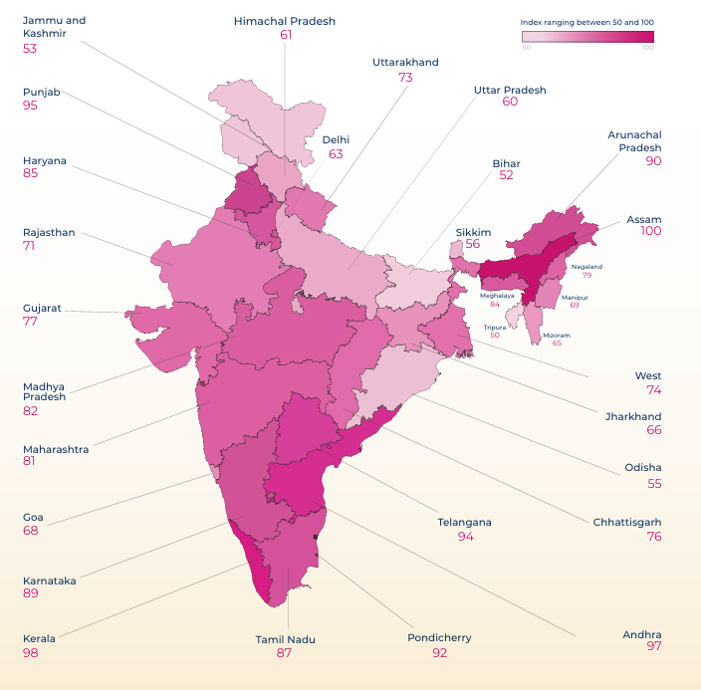
The report also includes an index which measures ease of travel for women in every state. This categorisation is created using a weighted index that considers women’s share of travellers nationally, the proportion of solo women travellers, and the number of women undertaking long-distance journeys above 500 km.
The top 5 states are -
Assam
Kerala
Andhra Pradesh
Punjab
Telangana
Gen Z Women Are Driving the Shift — and Are Comfortable Travelling Solo
Younger women are increasingly embracing independent travel, with confidence and intent driving a sharp rise in solo journeys
Gen Z women (14–29 years) make up 60% of all women passengers and account for 68% of solo women trips.
Women’s Bus Travel Is Being Driven by Small-Town India
68% of women bus travellers originate from Tier-2 and Tier-3 towns
This shift may be linked to rising workforce participation among women in smaller towns, alongside increased digital adoption that is improving access to travel options.
Women Travellers Plan Their Journeys Earlier
Women travellers show stronger planning habits, with 62% booking their bus tickets one or more days before travel, compared to 48% of men who book one or more days earlier.
Trust and Safety Signals Strongly Influence Women’s Travel Choices
47% of women prefer buses that are highly rated by other women passengers, underscoring the importance of peer trust in travel decisions
33% of women check how many other women have already booked seats on the bus
During the journey, service quality and safety-linked features play a critical role, with staff behaviour (50%) emerging as the most important factor, followed by the ability to share live tracking with trusted contacts (48%)
Prakash Sangam, CEO, redBus, commented on the launch: “Women’s travel in India today reflects more than just rising journeys; it signals a growing sense of independence. More women across India are choosing to travel on their own terms, for work, education, opportunity or leisure. At redBus, we are continuously strengthening features that build trust, from better visibility of bus ratings by women, to enhanced safety information and dedicated support systems. Our goal is to continue to make intercity travel more reliable, more accessible and more empowering for every woman - whether she is travelling alone or leading a group. We believe mobility is freedom, and freedom should be seamless.”
Looking ahead, women’s participation in intercity bus travel is expected to continue rising as digital adoption deepens, connectivity improves, and access to online travel platforms expands across the country. Growing confidence in bus travel, particularly among travellers from smaller towns, is likely to further accelerate this shift towards more independent and purpose-driven journeys. At the same time, continued improvements in road infrastructure and travel comfort are expected to make bus travel more accessible to a wider range of women travellers, reinforcing its role as an important enabler of mobility and opportunity across India.