redBus Data Shows GenZ Leads India’s Spiritual Travel Segment with 53% Share

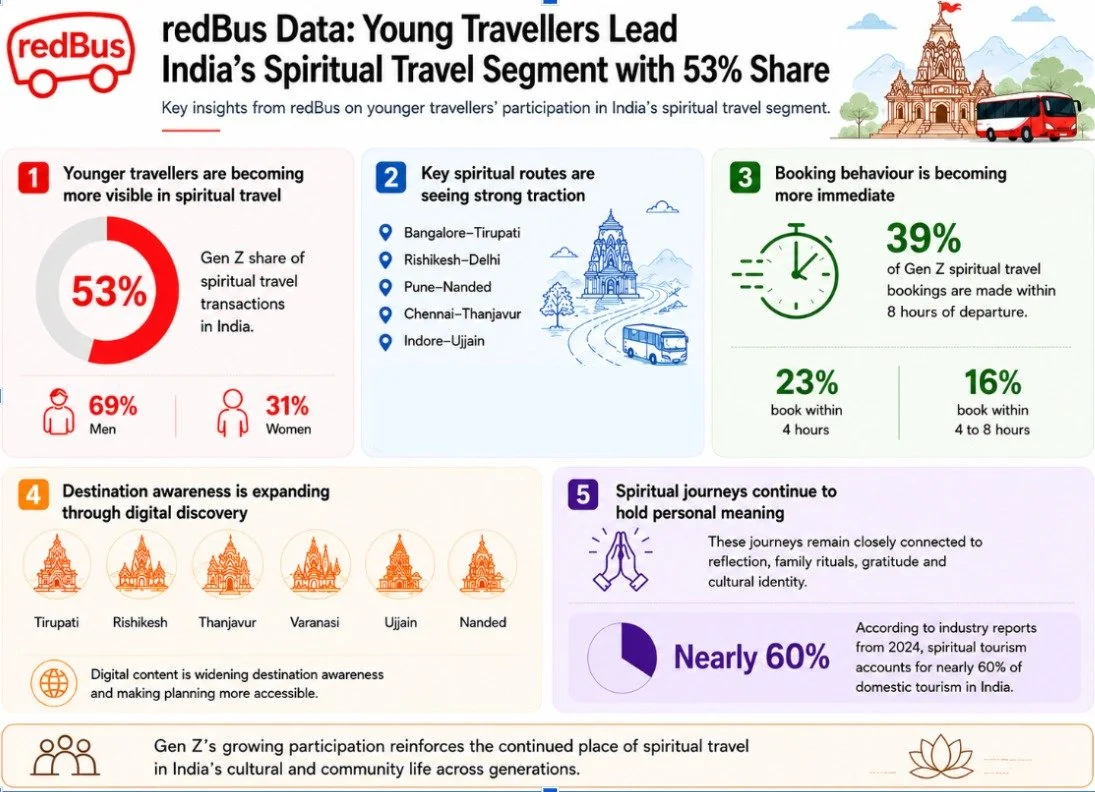
India’s spiritual travel segment continues to see strong participation across generations, with younger travellers becoming increasingly visible across key routes and destinations to religious and pilgrimage destinations. Data from redBus, the world’s largest online bus ticketing platform, indicates that Gen Z and young travellers now account for more than 53% of travelers to spiritual destinations in FY26. This marks a notable rise over the corresponding period in FY25, making them a significant cohort in this category.

1. Younger travellers are becoming more visible in spiritual travel

Gen Z and young travellers now account for nearly 53% of travel to spiritual destinations in India, making them the largest cohort in this category. Men account for nearly 69% of these travellers, while women contribute around 31%. This reflects a stronger youth presence in a segment that has long held deep cultural, familial and personal significance in India.

2. Key spiritual routes are seeing strong traction

Corridors such as Bangalore–Tirupati, Hyderabad–Tirupati and Rishikesh–Delhi, Pune-Nanded, Chennai-Thanjavur, Indore-Ujjain are seeing notable traction among Gen Z travellers. The Bangalore–Tirupati corridor alone logged lakhs of GenZ travellers, highlighting strong demand across established spiritual routes. It also points to the role of easier access and digital booking in helping younger travellers plan these journeys with greater convenience.

3. Booking behaviour is becoming more immediate

Spiritual journeys are not always planned far in advance, especially among younger travellers. The share of bookings made within the first four hours alone has increased from 16% in 2022 to nearly ¼ (23%) in 2026. This reflects the convenience of mobile-first access and a growing comfort with close-to-departure planning. Travel decisions may be influenced by important dates, family plans, personal schedules or sudden availability .

4. Destination awareness is expanding through digital discovery

Family guidance, community recommendations and traditional travel routes continue to play an important role in travel to spiritual destinations. Alongside this, digital content is helping bring spiritual destinations into the consideration set of younger travellers, through route information, travel videos, devotional music, destination visuals and shared community experiences. This is helping places such as Tirupati, Rishikesh, Thanjavur, Varanasi, Ujjain and Nanded remain visible among young travellers. Digital discovery is not altering the purpose of these journeys; it is widening awareness and making planning more accessible through channels familiar to this cohort.

5. Spiritual journeys continue to hold personal meaning

Spiritual travel continues to remain closely linked to family traditions, cultural continuity and personal belief among younger travellers. Industry reports from 2024 estimate that spiritual tourism contributes nearly 60% of domestic tourism in India, underlining the scale and relevance of the segment.

Gen Z’s growing participation does not change the essence of travel to spiritual destinations. It reinforces its continued place in India’s cultural and community life. As younger travellers become more active on these routes, the segment is gaining wider visibility across age groups, supported by easier access, digital planning and intergenerational relevance. For young India, these journeys remain anchored in tradition, family, culture and a deeper personal connection to spiritual destinations.

India BusTrack by redBus reports 147 Million Passengers Travel in 6 months; showing a 24% increase

●       This report focuses on the Andhra Pradesh - Telangana region

●       Young travellers between 18-36 shape intercity bus demand, contributing to 69% of bookings on redBus. 62% of bus journeys originate in small cities and towns

National, May , 2026: redBus, the world’s largest online bus ticketing platform, has released the latest edition of its India BusTrack Report, a comprehensive tracker of intercity bus travel trends across passengers, regions and private operators in India. The report spotlights the evolving scale and momentum of India’s intercity bus sector for the period from October 2025 to March 2026 and the corresponding period in the previous years.

Intercity buses carried 147.19 million passengers from October 2025 to March 2026 in India, reflecting a 24% increase in passenger volumes compared to the same period in the previous years. Gross ticketing value increased by 20% to ₹142.16 billion. The number of active private operators also rose to more than 6,800 reflecting the widening operator base and strengthening network depth across India’s intercity routes. These numbers pertain to all Indian private operators, not just redBus.

The edition further highlights evolving traveller preferences across India’s intercity bus sector. Sleeper and hybrid buses accounted for 86% of all journeys, while AC buses accounted for 72%, reflecting sustained demand for comfort-led and longer-distance travel.

 Key Highlights from the Report:

 Insights from overall Indian intercity bus industry

Data pertains to all private bus inventory connected to redBus platform; just redBus sales

 ●       Route Expansion: Unique routes grew by 31%, while towns connected increased by 12% over April–September 2025, underscoring the continued expansion of organised intercity bus travel and deeper connectivity across India’s smaller towns and cities.

●       Service Preference: AC services comprised 72% of journeys, underscoring travellers’ growing preference for comfort-led intercity travel.

●       Long-Haul Mobility: Nearly 2/3 (64%) of routes were over 250 km

●       Seat Booking Trends : Maharashtra & Goa accounted for the highest share of total seat bookings at 16%, followed by Tamil Nadu (including Pondicherry) at 14%. Andhra Pradesh & Telangana together contributed 11%, and Karnataka also contributed 11%.

●       Occupancy Trends: Pan-India bus occupancy stood at 77%, with Andhra Pradesh and Telangana recording a higher occupancy than the national average at 83%.

Insights based on redBus bookings

 ●       Core Traveller Cohort: Young travellers dominated bookings, with the 18–36 age group accounting for 69%; increasingly, there is a growing contribution of Gen Z, travellers. Male passengers comprised 66% of travellers.

●       Geographical Distribution of Bookings: Smaller cities and towns continued to drive digital bus ticketing, with 62% of bus journeys originating in small cities and towns

Insights from Andhra Pradesh-Telanga

 ●       Within region travel dominates: Intra-regional travel accounts for 69% of the total travel, while inter-regional travel contributes 31%

●       Higher seat prices: The average ticket price for bus journey in this region is INR 1016; higher than the all India average of INR 966

●       Bus occupancy: This region has the highest bus occupancy at 83%; while all India occupancy is at 77%

“This edition of India BusTrack covers the second half of the last financial year from October 1, 2025 to March 31, 2026. During this period, the intercity bus market grew by 24% in terms of passengers travelled, compared to the same period last year. Digitization has been rapid and the active bus operator count has increased to 6858. Due to the digitisation of many short route bus services, the average seat price (ASP) has dropped 3% this year to Rs.966. The industry recorded a healthy 77% occupancy during this period.

In this edition of BusTrack, the spotlight is on Andhra Pradesh and Telangana, two robust markets that have strongly driven the growth of India’s intercity bus industry. Interestingly, both states have consistently shown higher than national bus occupancy at around 83% since the latter half of 2025. The region also recorded a higher average seat price of Rs. 1,016, compared to the national average of Rs. 966. This indicates high customer demand and potential for bus operators looking to expand” said Prakash Sangam, CEO, redBus.

The full report will be available on the redBus blog, featuring detailed insights into industry growth, regional trends, route networks, passenger behaviour and booking patterns.

 Access it here:  https://www.redbus.in/blog/redbus-india-bustrack-report-october-2025-to-march-2026/

Young Travellers Expected to Account for 60% Seat Share from Delhi Amid Pilgrimage Travel Demand: redBus

Delhi, May, 2026: redBus, the world’s largest online bus ticketing platform, is witnessing a strong surge in intercity travel from Delhi ahead of the pilgrimage travel window. Data from the redBus platform indicates that bus bookings from Delhi are projected to grow by 28% between 1st May till 2nd June 2026 (compared to the same period last year), which includes Ganga Dushera, Nirjala Ekadashi, and summer holiday travel.  

redBus has witnessed surges on certain routes around specific pilgrimage dates. For instance, bookings on routes to Varanasi around Ganga Dussehra dates were approximately 40% higher than average, in 2025. Similarly, around Nirjala Ekadashi, bookings on routes to Khatushyamji were approximately 2X of the average summer bookings. 

The demand this year highlights the strong destination pull of Khatushyamji during Nirjala Ekadashi, with the shrine driving a significant share of bookings from the region. It reflects how key pilgrimage destinations are shaping short-window travel patterns around major religious observances and also reinforces the continued importance of buses as a preferred mode of transport for devotees. Some key destinations, as per bookings on the redBus platform, are:


Top Routes to Pilgrimage Destinations:

  • Delhi-Rishikesh

  • Delhi-Haridwar

  • Delhi-Varanasi

  • Delhi-Khatushyamji

  • Delhi-Katra (jammu and kashmir)

Top Boarding Points by traffic 

  • ISBT Kashmiri Gate

  • Dhaula Kuan

  • Akshardham Metro Station

  • Morigate

  • Anand Vihar

  • Karol Bagh

Travellers’ Preferences

  • Seater buses account for a slightly higher share of bookings at 54%, while sleeper services stand at 46%, reflecting demand across both day and overnight travel formats. 

  • Travellers in the 18–30 age group account for 60% of the seat share, underscoring the strong participation of younger travellers.

  • Male travellers account for 72% of the total, of whom 60% are young travellers (18-30). Female travellers make up 28% of total bookings, of whom 60% are young travellers (aged 18–30). 

Together, these trends indicate a strong rise in pilgrimage-led travel from Delhi around Nirjala Ekadashi, supported by advance travel planning and the growing preference for convenient intercity bus services. As devotees undertake short-duration spiritual journeys during this high-demand religious travel window, redBus continues to strengthen access across key pilgrimage corridors, enabling travellers to plan and complete their journeys with greater ease and reliability. 

Women’s Bus Travel Surges 136% Since 2019, Outpacing Overall Passenger Growth: redBus Pink report

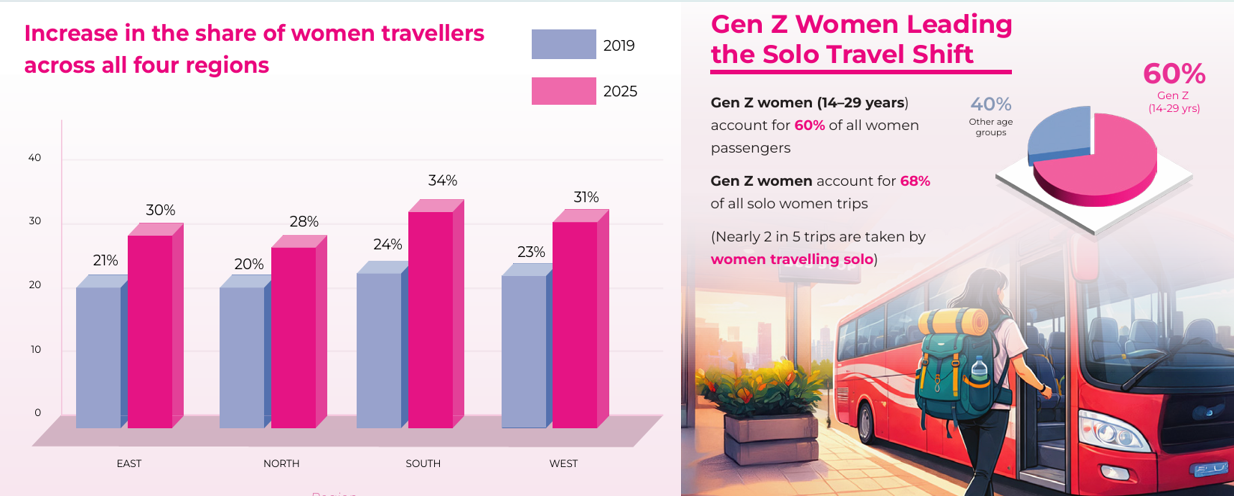
National, March, 2026: redBus, the world’s largest online bus ticketing platform, released insights from its first-of-a-kind redBus Pink Report during International Women’s Week. Based on internal data between 2019 and 2025, the report highlights a steady rise in how women are reshaping India’s intercity mobility landscape. According to the study, women’s bus travel has surged by 136% since 2019, nearly double the pace of overall passenger growth at 72%. Women now make up one in three intercity bus travellers (33%), up from 23% in 2019, with much of the momentum driven by Gen Z travellers, rising solo journeys, and growing adoption across Tier-2 and Tier-3 towns. Together, these trends highlight a broader shift towards greater independence, participation, and mobility for women across India.

The redBus Pink Report is a data-driven analysis of women’s intercity and interstate bus travel across India, categorising states based on women’s travel patterns. Built using redBus’ internal data between 2019 and 2025 across both private and RTC (government) buses available on the redBus platform, the study tracks how women’s bus travel has evolved and highlights regions where adoption is accelerating. The study aims to highlight women’s travel trends across regions and contribute to broader mobility discussions.

Here is the link to the full report: 

Key highlights:

  • Women Are Driving the Growth of Intercity Bus Travel

  • 136% increase in women travelling in 2025, compared to 2019, outpacing overall passenger growth, which stands at 72% 

  • Women’s share of bus travellers increased from 23% in 2019 to 33% in 2025

  •  The Rise in Women Bus Travel Is a Pan-India Phenomenon

  • South India continues to lead women’s bus travel participation, rising from 24% in 2019 to 34% in 2025, while other regions have also seen steady growth - West from 23% to 31%, East from 21% to 30%, and North from 20% to 28%.

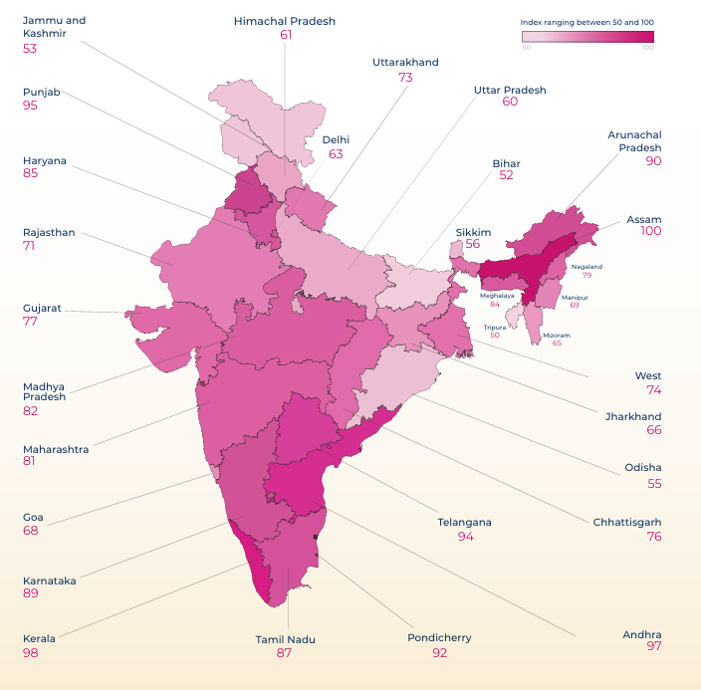
  • The report also includes an index which measures ease of travel for women in every state. This categorisation is created using a weighted index that considers women’s share of travellers nationally, the proportion of solo women travellers, and the number of women undertaking long-distance journeys above 500 km.

  • The top 5 states are - 

    • Assam

    • Kerala

    • Andhra Pradesh

    • Punjab

    • Telangana 

  • Gen Z Women Are Driving the Shift — and Are Comfortable Travelling Solo 

  • Younger women are increasingly embracing independent travel, with confidence and intent driving a sharp rise in solo journeys

  • Gen Z women (14–29 years) make up 60% of all women passengers and account for 68% of solo women trips.

  • Women’s Bus Travel Is Being Driven by Small-Town India

  • 68% of women bus travellers originate from Tier-2 and Tier-3 towns 

  • This shift may be linked to rising workforce participation among women in smaller towns, alongside increased digital adoption that is improving access to travel options.

  • Women Travellers Plan Their Journeys Earlier

    • Women travellers show stronger planning habits, with 62% booking their bus tickets one or more days before travel, compared to 48% of men who book one or more days earlier.

  •  Trust and Safety Signals Strongly Influence Women’s Travel Choices 

    • 47% of women prefer buses that are highly rated by other women passengers, underscoring the importance of peer trust in travel decisions

    • 33% of women check how many other women have already booked seats on the bus

    • During the journey, service quality and safety-linked features play a critical role, with staff behaviour (50%) emerging as the most important factor, followed by the ability to share live tracking with trusted contacts (48%)

Prakash Sangam, CEO, redBus, commented on the launch: “Women’s travel in India today reflects more than just rising journeys; it signals a growing sense of independence. More women across India are choosing to travel on their own terms, for work, education, opportunity or leisure. At redBus, we are continuously strengthening features that build trust, from better visibility of bus ratings by women, to enhanced safety information and dedicated support systems. Our goal is to continue to make intercity travel more reliable, more accessible and more empowering for every woman - whether she is travelling alone or leading a group. We believe mobility is freedom, and freedom should be seamless.”

Looking ahead, women’s participation in intercity bus travel is expected to continue rising as digital adoption deepens, connectivity improves, and access to online travel platforms expands across the country. Growing confidence in bus travel, particularly among travellers from smaller towns, is likely to further accelerate this shift towards more independent and purpose-driven journeys. At the same time, continued improvements in road infrastructure and travel comfort are expected to make bus travel more accessible to a wider range of women travellers, reinforcing its role as an important enabler of mobility and opportunity across India.