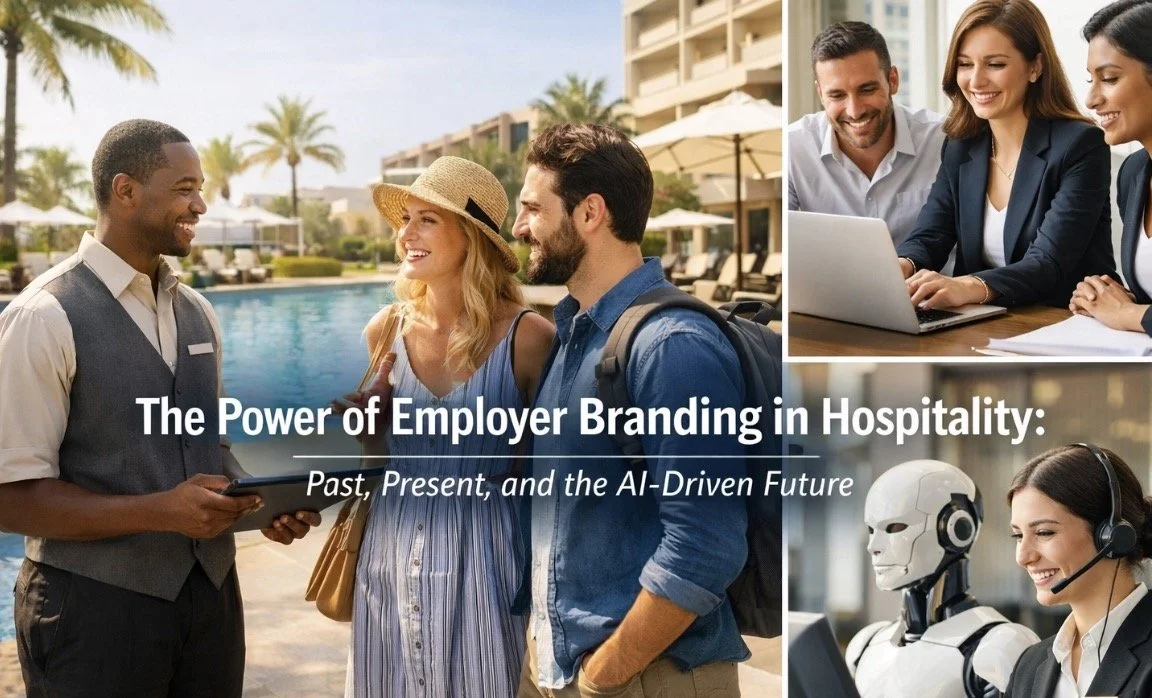
The Power of Employer Branding in Hospitality: Past, Present, and the AI-Driven Future
/![[HERO] The Power of Employer Branding in Hospitality: Past, Present, and the AI-Driven Future](https://cdn.marblism.com/9r0ZhGxUFQn.webp)
Let's be honest, hospitality has always been about people. But here's the thing: for decades, we've been so focused on the guest experience that we forgot about the other half of the equation. The team behind the scenes. The ones who make magic happen at 2 AM when a guest needs something extraordinary, or who remember a regular's coffee order without asking.
Today, employer branding isn't just HR jargon, it's the lifeline that determines whether your property thrives or struggles to keep its doors staffed. And with the industry's turnover rate exceeding 75% annually in some segments, we need to talk about this. Really talk about it.
Where We Came From: The Evolution of Hospitality Careers
There was a time when hospitality jobs were seen as temporary stops, something you did while figuring out your "real" career. Front desk? Just a summer gig. Housekeeping? A stepping stone. Kitchen work? Well, unless you were climbing toward that elusive head chef position, it wasn't exactly dinner party conversation material.
But something shifted over the past few decades. The industry started recognizing that exceptional service doesn't come from transient workers: it comes from invested professionals who see hospitality as a calling, not a paycheck. Hotel management programs emerged. Culinary schools became prestigious. Suddenly, a career in hospitality meant something.
The transformation was gradual but undeniable. Properties began offering structured career paths. Training programs evolved beyond "here's how to fold a napkin" into comprehensive leadership development. Benefits improved. The narrative changed from "just a job" to "a profession worth pursuing."
Yet even with this progress, we still faced a fundamental challenge: how do we communicate that shift to the next generation of talent? How do we convince someone scrolling through job listings that working at our property isn't just employment: it's belonging to something meaningful?
That's where employer branding entered the conversation.

The Current Landscape: Why Your Reputation as an Employer Matters More Than Ever
Here's a statistic that should make every hospitality leader pause: 60% of job seekers identify company culture as a deciding factor when applying for a job. Not salary. Not location. Culture.
Your employer brand is your reputation and image as an employer: it encompasses your values, work environment, and the promise you make to everyone who joins your team. In practical terms? It's what people say about working for you when you're not in the room.
And right now, with talent shortages hitting every segment of hospitality, your employer brand might be the only thing standing between you and chronic understaffing.
The Employee Value Proposition: More Than Just a Paycheck
Smart properties today are building comprehensive Employee Value Propositions (EVPs) that go beyond competitive wages. We're talking about:
Career Development Opportunities: Clear pathways from entry-level positions to leadership roles. Cross-training programs. Mentorship initiatives. Because when someone sees a future with you, they're more likely to invest in the present.
Work-Life Balance: Revolutionary concept in hospitality, we know. But properties that crack this code: flexible scheduling, mental health support, respecting time off: are seeing dramatic improvements in retention.
Recognition and Belonging: Regular acknowledgment of achievements. Performance bonuses tied to both individual and team success. Creating an environment where people feel valued, not just utilized.
Companies with strong workplace cultures experience up to 59% lower turnover. That's not a marginal improvement: that's transformational.
Digital Presence: Your First Interview
Before anyone walks through your door for an interview, they've already formed an opinion about you. They've checked your website, scrolled through your social media, read employee reviews on Glassdoor, and maybe even asked around in industry groups.
Leading hospitality brands understand this. Take Marriott's approach: they've created video series showcasing real employee success stories, from housekeepers who became general managers to F&B staff who launched their own culinary concepts. These aren't polished corporate videos; they're authentic narratives that create emotional connections with potential candidates.
Your digital employer brand should highlight:
- Genuine employee testimonials and day-in-the-life content
- Your company values in action, not just as poster platitudes
- The perks and programs that make you different
- Your commitment to diversity, inclusion, and community impact

The Culture Factor: Beyond the Mission Statement
We've all seen those mission statements that sound inspiring in the boardroom but mean nothing on the floor. Real culture isn't what you say: it's what you do when things get tough.
It's how you treat your team during a crisis. Whether you celebrate wins together. If feedback flows both ways. Whether your leaders work alongside the team or just observe from a distance. If mistakes become learning opportunities or blame games.
Properties known for exceptional employer brands tend to share common traits: collaborative environments, transparent communication, genuine investment in employee wellbeing, and leadership that models the values they preach.
The Future is Here: How AI is Reshaping Employer Branding
Now, let's talk about where we're headed: because the AI revolution isn't just transforming guest experiences; it's completely reimagining how we attract, develop, and retain talent.
Smarter Recruitment Through AI
Traditional recruitment in hospitality has been, frankly, exhausting. Sorting through hundreds of applications, scheduling interviews across multiple shifts, trying to identify which candidates will actually thrive in your environment: it's time-consuming and imprecise.
AI-powered recruitment platforms are changing this game:
Automated Screening and Matching: AI can analyze applications against your specific requirements, cultural indicators, and success patterns from your best performers. This doesn't replace human judgment: it enhances it by ensuring you're spending time with the most promising candidates.
Chatbot Pre-Screening: Imagine a potential applicant visiting your careers page at midnight (because that's when they're free) and getting immediate responses to their questions, an application walkthrough, and even a preliminary screening: all before a human recruiter clocks in the next morning.
Bias Reduction: Properly trained AI systems can help minimize unconscious bias in initial screening, ensuring diverse candidates get fair consideration based on skills and potential rather than superficial factors.
Sentiment Analysis: Understanding Your Team in Real-Time
Here's something we've always struggled with: knowing how our team actually feels before small issues become big problems.
AI-powered sentiment analysis tools can now monitor engagement surveys, feedback channels, and even communication patterns to identify:
- Early warning signs of burnout or disengagement
- Departments or shifts with morale challenges
- What's working well and should be amplified
- Individual employees who might be flight risks
This isn't Big Brother surveillance: it's intelligent listening that allows proactive support before someone walks out mid-shift or gives their two weeks' notice.

Personalized Career Paths: Because One Size Never Fit All
Remember when career development meant following the same rigid ladder everyone else climbed? AI is demolishing that outdated model.
Modern AI systems can analyze an employee's skills, interests, performance patterns, and aspirations to create truly personalized development plans. A front desk agent interested in revenue management might get targeted training recommendations. A housekeeper with leadership potential could be fast-tracked into supervisory programs. Someone passionate about sustainability might be connected with green initiatives across the organization.
This level of personalization was impossible at scale before. Now? It's becoming standard practice at forward-thinking properties.
The Impact: Why This Actually Matters
Let's connect the dots between employer branding and what keeps you up at night as a hospitality leader.
Operations: The Bottom-Line Benefits
Strong employer branding can reduce recruiting costs by 50%. Think about that. Half your recruitment budget saved because people want to work for you, rather than you desperately searching for anyone willing to fill a position.
Lower turnover means:
- Reduced training costs (you're not constantly onboarding replacements)
- Better operational consistency (experienced teams work more efficiently)
- Improved guest satisfaction (continuity of service matters)
- Less manager burnout (they're developing talent, not perpetually hiring)
Customer Satisfaction: The Direct Connection
Here's something we've known intuitively but now have data to prove: happy employees create happy guests.
When your team feels valued, invested in, and proud of where they work, it shows. In their genuine smiles. Their willingness to go the extra mile. Their ability to handle difficult situations with grace. Their enthusiasm when recommending your property to others.
Properties with strong employer brands consistently score higher on guest satisfaction metrics. Because you can train someone to check in a guest, but you can't train genuine care: that comes from an employee who feels genuinely cared for.
Employee Satisfaction: Creating Belonging and Growth
At its core, powerful employer branding creates three essential feelings:
Belonging: This isn't just a job; this is my place. My team. My second family.
Growth: I'm not stuck here; I'm building something. Learning. Advancing. Becoming better at what I do.
Pride: When someone asks where I work, I light up. Because I'm proud to be associated with this brand, these people, this mission.
When employees feel these things, magic happens. Retention improves. Performance elevates. Your property becomes known not just as a great place to stay, but as a great place to work.

Building Your Employer Brand: Where to Start
If you're reading this thinking "we need to work on this," you're already ahead of many properties still treating recruitment as a transactional necessity rather than a strategic priority.
Start by asking your current team what working for you is actually like. Not in a formal survey they'll cautiously navigate: in real conversations. What do they love? What frustrates them? Why do they stay? What would make them leave?
Then audit your digital presence. Google your property's name plus "working at" or "employee reviews." What story is being told? Is it the story you want told?
Define your EVP clearly. What makes working at your property different from the hotel down the street? If you can't answer that compellingly, neither can potential candidates.
Invest in your current team. The best recruitment tool is a happy employee who tells their friends, "You should work here." Retention is the foundation of employer branding.
The Road Ahead
The hospitality industry is at an inflection point. The old model: relying on an endless supply of willing workers: is broken. The new model requires intentionality about who we are as employers and how we communicate that identity to the world.
AI will accelerate this transformation, making it possible to personalize, optimize, and enhance every aspect of the employee journey. But technology is only as good as the culture it supports.
At the end of the day, employer branding in hospitality comes down to a simple truth: if you take care of your people, they'll take care of your guests. Everything else is just strategy to make that happen more effectively.
The properties that understand this: that invest in building genuine, compelling employer brands: won't just survive the talent crisis. They'll thrive through it, attracting the industry's best talent while their competitors scramble to fill positions.
Because in hospitality, people aren't just your most important asset. They're the only asset that truly matters.
Research and insights compiled by the hospemag team. For more hospitality industry analysis and trends, visit hospemag.me.