
Who Owns The Next Action After an AI Reply
/By Kyunghan Bae, CEO, UNICUP COMPANY
Consider a café confirming a group order of twelve drinks for collection at 11.30 a.m. An AI draft says the order can be ready. A manager sends the reply and then finishes the shift. The next team has the message, but nobody has accepted responsibility for checking stock, scheduling preparation or contacting the organiser if something changes.
The guest has received a promise. The team has inherited a task that may still be unassigned.
For café and restaurant managers, the useful question is what happens after a reply leaves the screen. A clear handover makes the commitment visible to the people who must deliver it.
Check the promise before sending
Read a draft for the actions it creates. A sentence such as “We can have everything ready by 11.30” commits the team to a quantity, a time and a collection arrangement. Checking grammar will not establish whether those commitments are possible.
Keep current operating facts in one place: today’s availability, preparation lead times, collection arrangements and the person who can approve an exception. Give each entry an owner and a review date. If the information has not been checked, the reply should say when the guest will receive confirmation.
For example: “I’ll check availability with the shift manager and confirm your collection time by 10 a.m.” That sentence creates a manageable next action with a deadline.
Give the receiving team a usable record
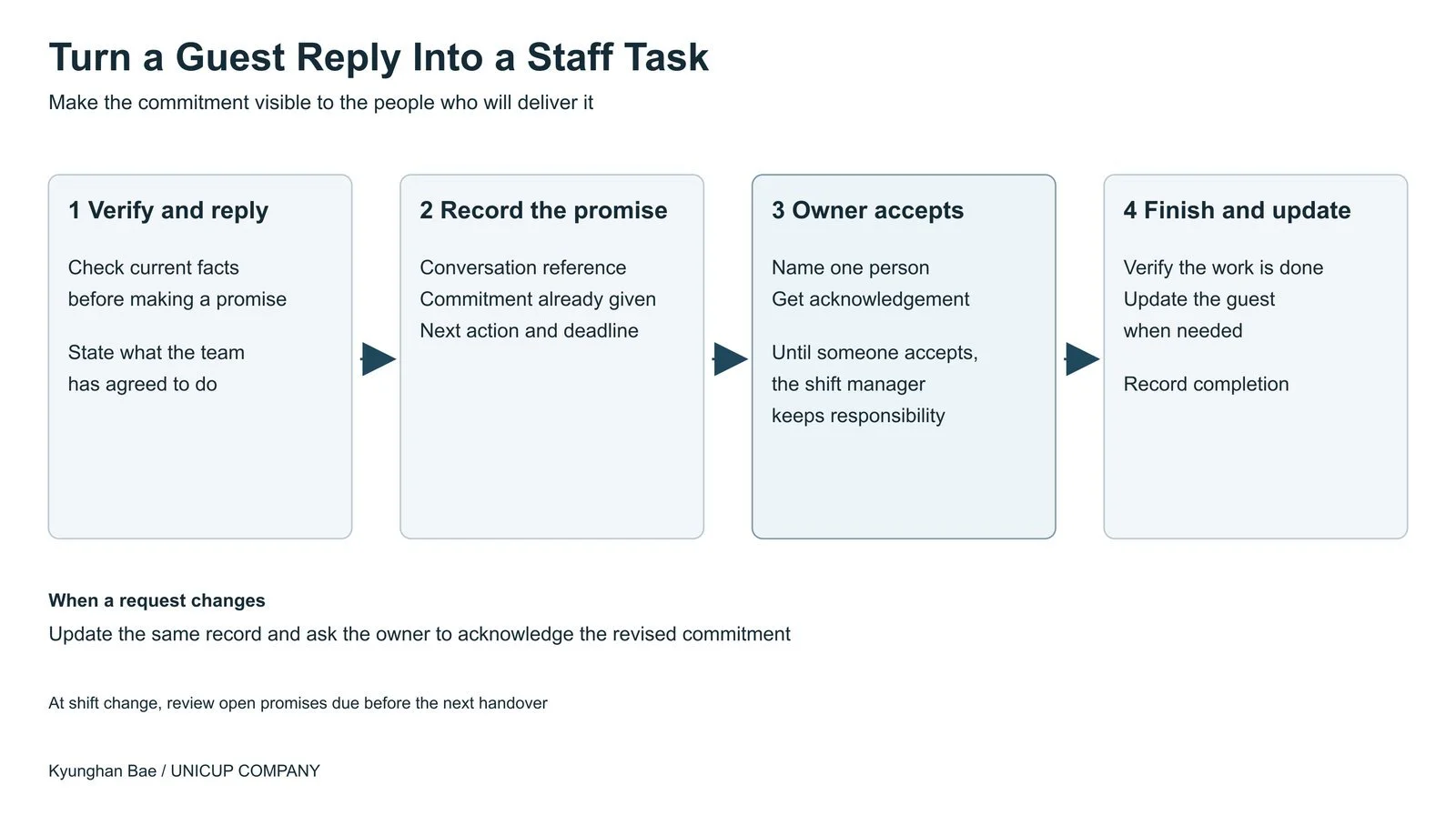
A full message thread can be useful evidence, but the incoming team needs the request and the next action at a glance. Use a short record with these fields:
Guest request and reference: what is needed and how to find the conversation.
Commitment: exactly what the guest has already been told.
Next action: the check or preparation still required.
Owner and deadline: who has accepted the task and when it is due.
Completion: what happened and whether the guest was updated.
Keep the guest’s personal details in the existing approved system; use a reference in the handover sheet. Avoid copying entire conversations into an open staff chat.
Before leaving, ask the receiving colleague to acknowledge the task. A read receipt shows that a message was opened. An acknowledgement such as “I have this order and will confirm stock before 10” establishes responsibility. If nobody accepts it, the shift manager keeps ownership.
Make uncertainty visible
Take a second example: a guest asks whether a seasonal drink is available for tomorrow’s collection. A reply based on yesterday’s menu may be perfectly written and still be wrong.
The colleague checking stock should record when the check happened and whether the ingredients have been reserved. The person replying should then use that result. If tomorrow’s availability remains uncertain, offer a time for confirmation or ask whether an alternative would suit the guest. Confirm the substitution before preparing it.
This approach also helps when a guest changes the quantity after an initial reply. Update the same request record, flag the changed commitment and ask the owner to acknowledge the revision. Otherwise, two teams may prepare two different versions of the order.
Close the request when the work is done
A sent message is one step in handling a request. Close the record when the promised action has happened, the result has been recorded and any necessary guest update has been sent.
At shift change, review open promises due before the next handover. Give overdue items to a named manager rather than leaving them in a shared inbox. Keep an agreed route for urgent changes when the owner is off duty.
Start with a single request type, such as advance collection orders, and review it for a week. Count requests handed over without an acknowledged owner, promises that became overdue and guests who had to repeat their request. Read the missed cases together. They can reveal an unclear deadline, old menu information or a task that nobody accepted.
An AI reply can help a team respond quickly. The operating discipline is to make every promise visible, assign the next action and verify completion. The guest should experience one service team, even when several people handle the request.
About the author: Kyunghan Bae is CEO of UNICUP COMPANY, which directly operates UNICUP Coffee at BIFC in Busan, South Korea. His work covers foodservice operations, menu and brand communication, and practical operating tools. He writes about how service teams check information, assign responsibility and complete the actions promised to guests.
LinkedIn: linkedin.com/in/kyunghan-bae
Featured photo: Ketut Subiyanto / Pexels. Diagram: Kyunghan Bae / UNICUP COMPANY