redBus Data Shows GenZ Leads India’s Spiritual Travel Segment with 53% Share
/
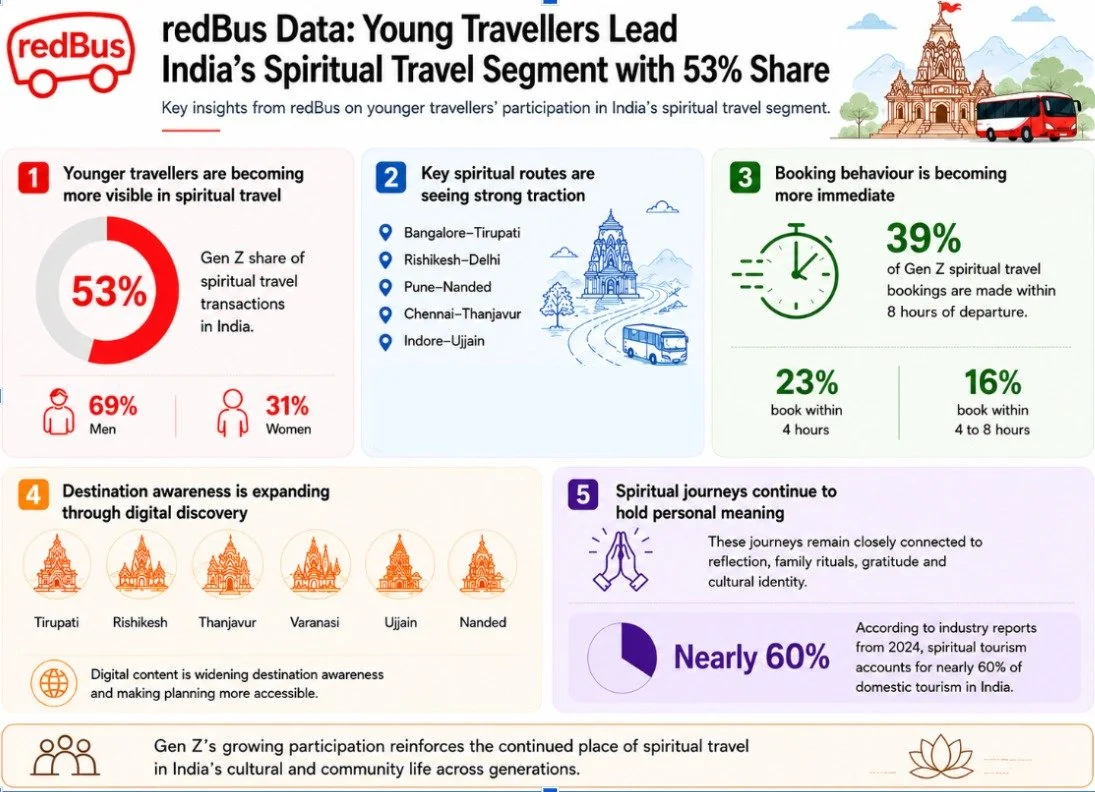
India’s spiritual travel segment continues to see strong participation across generations, with younger travellers becoming increasingly visible across key routes and destinations to religious and pilgrimage destinations. Data from redBus, the world’s largest online bus ticketing platform, indicates that Gen Z and young travellers now account for more than 53% of travelers to spiritual destinations in FY26. This marks a notable rise over the corresponding period in FY25, making them a significant cohort in this category.
1. Younger travellers are becoming more visible in spiritual travel
Gen Z and young travellers now account for nearly 53% of travel to spiritual destinations in India, making them the largest cohort in this category. Men account for nearly 69% of these travellers, while women contribute around 31%. This reflects a stronger youth presence in a segment that has long held deep cultural, familial and personal significance in India.
2. Key spiritual routes are seeing strong traction
Corridors such as Bangalore–Tirupati, Hyderabad–Tirupati and Rishikesh–Delhi, Pune-Nanded, Chennai-Thanjavur, Indore-Ujjain are seeing notable traction among Gen Z travellers. The Bangalore–Tirupati corridor alone logged lakhs of GenZ travellers, highlighting strong demand across established spiritual routes. It also points to the role of easier access and digital booking in helping younger travellers plan these journeys with greater convenience.
3. Booking behaviour is becoming more immediate
Spiritual journeys are not always planned far in advance, especially among younger travellers. The share of bookings made within the first four hours alone has increased from 16% in 2022 to nearly ¼ (23%) in 2026. This reflects the convenience of mobile-first access and a growing comfort with close-to-departure planning. Travel decisions may be influenced by important dates, family plans, personal schedules or sudden availability .
4. Destination awareness is expanding through digital discovery
Family guidance, community recommendations and traditional travel routes continue to play an important role in travel to spiritual destinations. Alongside this, digital content is helping bring spiritual destinations into the consideration set of younger travellers, through route information, travel videos, devotional music, destination visuals and shared community experiences. This is helping places such as Tirupati, Rishikesh, Thanjavur, Varanasi, Ujjain and Nanded remain visible among young travellers. Digital discovery is not altering the purpose of these journeys; it is widening awareness and making planning more accessible through channels familiar to this cohort.
5. Spiritual journeys continue to hold personal meaning
Spiritual travel continues to remain closely linked to family traditions, cultural continuity and personal belief among younger travellers. Industry reports from 2024 estimate that spiritual tourism contributes nearly 60% of domestic tourism in India, underlining the scale and relevance of the segment.
Gen Z’s growing participation does not change the essence of travel to spiritual destinations. It reinforces its continued place in India’s cultural and community life. As younger travellers become more active on these routes, the segment is gaining wider visibility across age groups, supported by easier access, digital planning and intergenerational relevance. For young India, these journeys remain anchored in tradition, family, culture and a deeper personal connection to spiritual destinations.