When LPG isn’t reliable, your team has to be
/Originally shared by Amar Ohri on LinkedIn
You don’t control the conditions
The recent LPG disruptions have once again placed kitchens in a space of uncertainty. For an industry built on precision and consistency, it feels familiar, echoing the early days of the COVID-19 pandemic when operations were forced to adapt overnight.
The question is the same. How long will this last? In hospitality, that question matters. The response matters more.
Protecting identity under pressure
At Ohris, the focus has not been limited to continuity. It has been about preserving what defines each brand.
Food is not treated as output alone. It carries memory, expectation, and consistency. During disruption, maintaining that becomes the priority.
Adapting across formats
Each brand responded based on its operational reality.
At Cake Nation, where production is closely tied to gas-based rotary ovens, teams introduced diesel-powered alternatives supported by electrical deck ovens. This allowed production to continue at scale with minimal compromise.
At Qaffeine, the transition was more seamless. With a largely electric setup already in place, a significant portion of the menu continued with limited disruption.
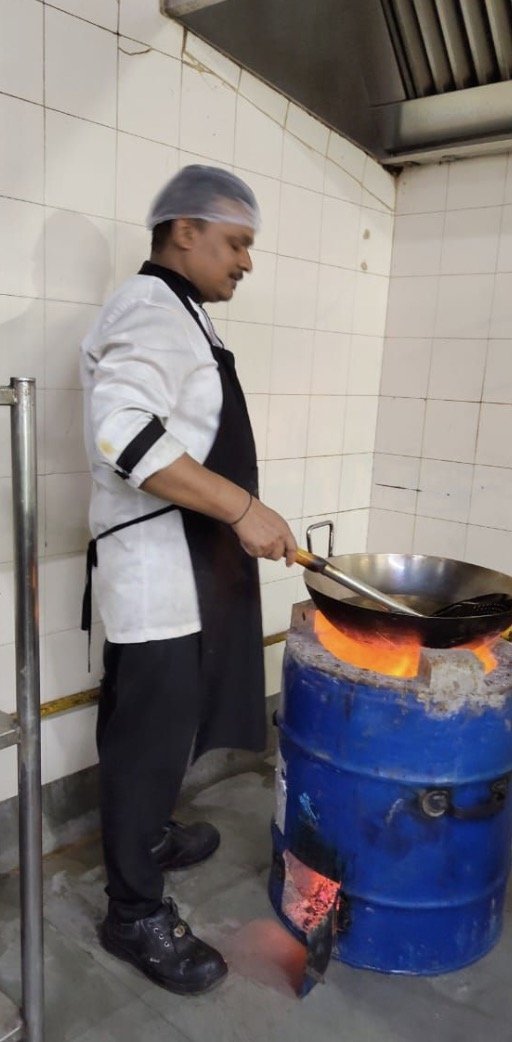
Fine dining kitchens such as Tansen and Sahib’s Barbeque leaned on traditional methods. Charcoal tandoors sustained key menu elements, while firewood-powered sigdis enabled centralised gravy preparation. Electrical equipment supported the remaining gaps.
Ming’s Court presented a more complex challenge. Chinese cuisine depends heavily on high flame cooking. Gas resources were prioritised here, while electrical systems were introduced to support surrounding processes.
Operational flexibility in real time
The response extended beyond individual kitchens. Menus were adjusted in real time. Equipment was reassigned across brands. Production was redistributed where needed. Desserts and components moved between units to maintain consistency. Despite the constraints, most restaurants continued to operate with 60 to 80 percent of their menus intact.
The role of the team
What stands out in moments like these is not only the operational response, but the behaviour of teams. Collaboration becomes fluid. Hierarchies soften. Individuals step beyond defined roles. There is a shared focus on ensuring that the guest experience remains unaffected. These are not processes that can be fully designed. They emerge from culture.
A moment to rethink
Disruptions often accelerate change. The COVID-19 pandemic reshaped how the industry approached technology, delivery, and remote operations. The current phase, while different in scale, presents a similar opportunity to rethink systems at a fundamental level.
In hospitality, resilience is not a reactive measure. It is an operating principle.
And often, the most meaningful progress comes when established ways of working are challenged.