Consistency Wins: The True Driver of Hospitality Brand Identity | Greg Chako, Chako Productions
/If variety is the spice of life, consistency is the recipe.
A Lesson from Singapore
Most of us have heard the saying, "Variety is the spice of life." In some situations, I agree. Variety can make life interesting, encourage discovery and surprise.
But after almost fifty years performing in restaurants, luxury hotels, resorts, and hospitality venues around the world, I've come to believe that guests rarely return because everything is different. No, they return because what mattered last time is still there!
When I go out to eat, it’s usually because I know that I will have a dish I can’t have by staying home. And, if I go to the trouble of leaving my house, I want my favorite dish. I’m going to a specific place because they have what I like and want. My expectations have been set. I know what the place looks like, how it smells, what kind of ambience or music they have, who the servers are, what it will cost, and whether or not I need to bring a sweater because the air-conditioning is set too high for my comfort. I know exactly how I will feel when I get all that I came for. But if the management has changed up all of a sudden, “spiced things up” if you will … my expectations have not been met and I’m truly disappointed. I might even walk out.
When I was working full-time as a professional musician and entertainment contractor in Singapore from 1995 through 2003, Karan Singh managed the Bar & Billiard Room at Raffles Hotel for several of those years. That's where I performed six nights a week. His genuine commitment to guest service, cheerful personality, and remarkable ability to remember the preferences of regular patrons made him a joy to work with. We became excellent partners, so when he accepted a maître d' position at Morton's of Chicago Steakhouse on the fourth floor of The Oriental Singapore, I was genuinely sorry to lose him.
Not long afterward, Karan invited me to dinner. It was my first visit to Morton's, and the experience made an immediate impression. Rich mahogany paneling, large leather booths, subdued colors, and warm lighting combined to create a cozy yet elegant atmosphere. The bar was lively, the staff polished, personable, and highly knowledgeable. Before guests ordered, servers presented the cuts of meat tableside, often accompanied by live Maine lobster to demonstrate the freshness of the seafood. The wine cellar was exceptional and, as one might expect, so were the prices.
I never forgot what a remarkable dining experience it was. During my years in Singapore, I returned time and again for that steak and that impeccable service. Fast forward to 2017, when I moved back to Cincinnati, Ohio. There was a Morton's there, and naturally I wanted to see whether the experience I remembered had survived the years.
It had.
Everything I remembered from Singapore was exactly as I found it in Cincinnati. That's why I went there. I hoped the experience would be every bit as satisfying as I remembered, and it was. To me, that's the power of a recognizable hospitality brand.
Morton's wasn't the only hospitality brand to leave such a lasting impression on me.
Though I lived and worked in Japan for six years, I was first introduced to kaiseki dining—the pinnacle of Japanese culinary art—at Nadaman, a renowned Japanese kaiseki restaurant, in Singapore's Shangri-La Hotel.
After moving to Japan, I experienced Nadaman there as well. I expected nothing less than excellence in Tokyo, but years later, while visiting New York City, I was pleasantly surprised to discover that the Nadaman there was every bit as good as the restaurants I had enjoyed in Singapore and Japan. The quality of the food, service, décor—and perhaps most importantly, the feeling in the room—was the same. That's why I went. That's why I'll keep coming back.
Live music in a hospitality setting is no different. Fine dining restaurants, elegant lounges, and even hotel lobbies need the right music, played at the right volume, by the right musicians. Once that combination has been found, it shouldn't be changed without a compelling reason. Like the menu, the service, and the décor, the music becomes part of what guests expect—and one of the reasons they return.
Over the years, I've often wondered why newly appointed General Managers and Food & Beverage Directors sometimes feel compelled to make changes simply because they're new to the property. Certainly, some changes are strategic and necessary. But when something is already working exceptionally well, change simply for the sake of change can do more harm than good. If it isn't broken, don't fix it.
During the mid-1990s, M.P.S. Puri directed all food and beverage operations at Raffles Hotel, including booking the entertainment for legendary venues such as the Bar & Billiard Room. He hired me to lead the music there in 1995.
Puri envisioned what he called The Connoisseur's Haven—an experience intentionally built around four complementary elements:
Premium Cuban cigars
Fine French chocolates
Scottish single malts
Live American jazz, providing a sophisticated acoustic backdrop
Together, they created exactly what Puri had envisioned: The Connoisseur's Haven.
During those first few years, management—not me—received more than thirty unsolicited letters addressed to Puri and General Manager Jennie Chua. They weren't simply compliments about the music. They described how the music enhanced the room and completed the overall guest experience.
"Chako and his jazz band was the crowning of a perfect evening. The mellow and sophisticated music of his excellent band was central to the timeless ambience that evoked a sense of elegant relaxation."
— Damian G. Fannin, Inflight Audio Ltd.
"I stayed for quite a time enjoying the music of Greg Chako and the atmosphere it brought to the room."
— Soren Melberg, Volvo Truck Corp., Sweden
"Greg and his band give the music a life of its own and infinitely enhance the image of the room."
— Lim Sing Yuen, Jitterbugs Swingapore
The Connoisseur's Haven was working.
Puri recognized it within weeks of our residency. His letter of October 9, 1995, wasn't simply a compliment to the band—it was confirmation that the concept he had envisioned was achieving exactly what he had hoped.
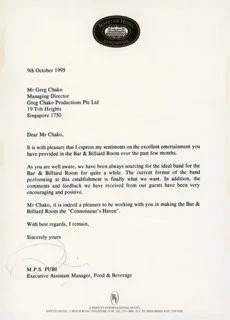
Letter from Puri dated October 9, 1995. Courtesy of Greg Chako, from his forthcoming memoir Jazzman—A Life Improvised.
Nothing was broken. Everything was working.
Business travelers from around the world came to Singapore several times each year. Many made one of their first stops the Bar & Billiard Room. I know this because they told me so. Just as I returned to Morton's for the steak I remembered and to Nadaman for the kaiseki dining experience I had come to expect, they returned to the Bar & Billiard Room because they knew what awaited them. They knew I'd be there. They knew the quality of the music. They knew the atmosphere. They knew Karan would remember their names and where they liked to sit.
Their expectations had already been established, and night after night those expectations were met.
Some guests were simply passing through Singapore. Before continuing their travels, they took the time to write remarkable letters describing the music they had unexpectedly discovered at Raffles. Several commented that, after traveling throughout the world, they had found some of the finest jazz they had ever heard. Others expressed surprise that they had discovered jazz of that quality in Singapore at all.
Then there were the returning guests.
Business brought them back to Singapore time and again.
Hideki Mori from Japan.
Matthew Weathered from Australia.
George Martin from British Airways.
Marcus and Koraa Faber-Møller from France.
They came to Singapore for business. They returned to the Bar & Billiard Room because they knew I'd be there. Over time, they came to associate the music with Raffles itself.
Like Morton's and Nadaman, the Bar & Billiard Room had become a recognizable brand. The Connoisseur's Haven worked because every element consistently reinforced the others. I was proud that our music had become one part of that identity.
Some years later, after Puri left to manage the pre-opening of The Fullerton Hotel, a new Executive Assistant Food & Beverage Manager was appointed. Despite nearly five years of leading the most successful band ever to appear at the Bar & Billiard Room, the new manager wanted to change the music dramatically. His favorite song at the time was Marc Anthony's You Sang to Me. I assembled an entirely new five-piece Latin vocal band. The singers performed in both Portuguese and Spanish. We played his favorite song, won the audition, and I continued managing the entertainment for another two years, ultimately outlasting multiple Food & Beverage Directors and General Managers.
Looking back, that dramatic change in musical direction marked the beginning of the end.
Too much spice.
Not enough consistency.
A Lesson from Cincinnati
When I first returned to my hometown of Cincinnati, it took time to establish myself as a working musician. The years I had spent managing entertainment programs for Starwood, Mandarin Oriental, Four Seasons, and Ritz-Carlton hotels, and performing for companies such as Goldman Sachs, Coca-Cola, Citibank, Louis Vuitton, and Toyota meant very little to most local venue owners.
Eventually, I secured a bi-weekly residency at an attractive new lounge. After drawing more than thirty people on my first Friday night with a jazz trio, the owner looked at me and said, "All these people came to see YOU!" I was affectionately dubbed the "house band." At first, everything seemed promising.
Over the following year, however, several problems became apparent.
First, the owner believed strongly in the "spice of life" approach to entertainment. Different musicians appeared each week, often performing completely different styles of music, from blues and fusion to singers, free improvisation, and jazz. There was little consistency from one weekend to the next.
Second, the owner wasn't a musician and therefore couldn't readily distinguish between seasoned professionals and what I like to call "instrument owners." If a band drew enough people, it was likely to be booked again regardless of the quality of the performance.
Third, the venue never developed its own loyal audience. The musicians were expected to supply the customers.
Fourth, because the entertainment schedule constantly changed, it became almost impossible to advertise the music consistently or establish a recognizable identity for the venue.
Finally, guests frequently complimented the music but complained about the food, the service, and the staffing. A restaurant rarely succeeds or fails because of the music alone. It succeeds or fails because of the total guest experience—how guests feel when they leave.
My trio was well received whenever we performed, but I never knew from month to month which Fridays, if any, I would be playing. So when guests told me how much they had enjoyed the evening and asked when they could return to hear us again, my answer was always the same:
"I don't know."
That single answer illustrated the problem perfectly. Without consistency there could be no expectation. Without expectation there could be no loyalty. And without loyalty, the music could never become part of the venue's identity.
Now there are music venues in Greater Cincinnati that have built recognizable brands. One of the best examples is Caffè Vivace, whose reputation has been reinforced by its inclusion in DownBeat magazine's prestigious international guide to jazz clubs.
Although the artists change from week to week, the standard of musicianship never does. The schedule is announced months in advance. Guests know exactly what kind of experience to expect. Before every performance, owner Brent Gallagher reminds the audience that Vivace is a jazz listening room and asks them to respect both the musicians and those who have come to listen. Not everyone appreciates the nightly reminder, but nobody walks into Caffè Vivace expecting anything other than what has been promised.
That's one of the hallmarks of a recognizable hospitality brand.
Sorrento’s - Partnership in Practice
In November 2024, Kyle Lucas, General Manager of Sorrento's Italian Joint in Norwood, Cincinnati, was looking for just the right music for the restaurant. Established in 1956 by Enrico and Santina DeLuca, Sorrento's underwent a complete renovation after being purchased by Bronson Trebbi, reopening in 2019. Kyle had heard good reports about me and called directly. We agreed to meet at the restaurant.
As I drove up and caught sight of the pizza sign, I wasn't entirely convinced this would be a good fit. Once I walked inside and saw the interior, I was immediately reminded of the small, family-owned Italian restaurants I had known while living and working in Brooklyn, New York. Charming? Absolutely. But my first thought was, "This doesn't seem like the Greg Chako brand."
That impression lasted only a few minutes.
As we talked, it quickly became clear that we shared the same vision for what a successful partnership could become. I explained that I wasn't interested in a one-off engagement. I was looking for a residency—same night, same time, same musicians—because that's the only way to build a loyal clientele, establish an identifiable atmosphere, and create an experience that eventually transcends either the food or the music alone. Consistency gives guests a reason to return. Over time, it becomes part of the venue's identity.
The idea made sense to Kyle.
We each had our own responsibilities. Kyle's job was to ensure consistently excellent food, service, staffing, and operations. Mine was to ensure consistently excellent music, appropriate volume, professionalism, guest interaction, and qualified substitutes whenever I couldn't be there. Different responsibilities, but one common objective: creating an experience guests would want to return to again and again.
At the outset, Kyle explained that the residency would begin with a six-month agreement because business traditionally slowed during the summer months. Then, in May 2025, he told me something neither of us expected. Their numbers had reached historic highs, and rather than ending the residency, he suggested we simply continue month to month. As I write this, Saturday night has become the busiest night of the week.
One of the 193 five-star Google reviews Chako Productions received came from Kyle himself:
"I've been lucky to have Greg Chako perform smooth jazz at Sorrento's Italian Joint restaurant weekly, and he never disappoints. His music sets the perfect vibe—relaxing and soulful without ever being overpowering. Greg is fantastic with guests, takes requests with ease, and really knows how to read the room. Our customers constantly compliment the atmosphere when he's playing. If you're looking for a true professional who enhances the dining experience, I highly recommend Greg."
Getting a steady residency anywhere is no small accomplishment. Yet whether we're talking about Raffles Hotel in Singapore or an independent Italian restaurant in Cincinnati, I've come to believe the principle is exactly the same.
Hospitality brands are built when management and musicians work as partners, consistently delivering the experience their guests have come to expect. Variety may be the spice of life, but consistency is what brings guests back.
— Greg Chako, Hospitality Entertainment Consultant & Professional Musician, Chako Productions LLC
Images: courtesy of Greg Chako